This shrine, dedicated to the
gods Yaekotoshironushi-no-mikoto, Ohnamuchi-no-mikoto and Amenohohi-no-mikoto,
has on its grounds a subsidiary shrine sacred to Nomi-no-Sukune, and Temmangu
Shrine.
Ishizu Shrine, founded by order on Emperor Kohsho in 7(B.C.469), is reportedly
the first in Japan to enshrine Ebisu (the god of commerce; the popular name of Yaekotoshironushi-no-mikoto).
According to records, the
Emperor Suinin(B.C.29-A.D.70) ordered Kehaya, the strongest man in the Taima
region (southern part of present Nara Pref.), to engage in a contest of
strength with Nomi-no-Sukune, 14th descendant of Amenohohi-no-mikoto
and the strongest man in the Izumo region (present Shimane Pref.).
Nomi-no-Sukune won the contest and was awarded the estate of Kehaya. (This is
considered the origin of the present national sport, Sumo wrestling.)
Also renowned for his
intellect, as reflected in his invention of placing haniwa clay figures around the emperor’s tomb instead of forcing the entourage
to buried together with the emperor. Nomi-no-Sukune was appointed chief
priest of Ishizu Shrine. The shrine as honored by the visits of Enperors
Kohtoku and Kohken in 652 and 749, respectively.
On the occasion of the latter’s visit, the Emperor granted the priest of
the shrine the name Fujiwara and the high ranking title of Ju-zammi Dainagon,
together with two villages (Sayama and Noda) in Kawathi region (southeast part
of Osaka prf.) as its domain.
When the Emperor Godaigo
visited the shrine, the priest was given a Kammuri and a pair of Kutu, ritual
headdress and footwear.
An ancient document from the
shrine says that at that time the shrine covered about 1㎢ and it was worshipped
as the local shrine which covered a wide area of Ishizu and its surroundings.
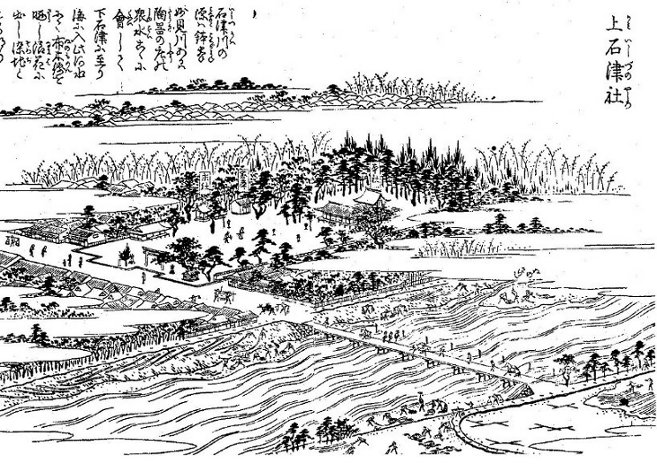
In the izumi meisho zue tour guide
book published during the Edo period in 1796, an illustration shows the
Ishizugawa River running directly south of the shrine and the local industry of
cotton bleaching “Ishizu no sarashi”, which used the pure and clean water of
the river.
It is also recorded that the
shrine had extensive grounds in those days. In 1909, Rokusho Shrine the deities
of village shrines of Kamiishi Ichino-cho area were enshrined together in
Ishizu Shrine and it began to protect a larger area.
"Ishidu's old literature V.3"
1742 Kanpo 2/the Edo era